

How Can an OCD Therapist Help Manage OCD Symptoms?
An OCD therapist at Kimina Counseling LLC in Auburn, MA gives you practical, evidence-based tools to quiet intrusive thoughts and stop repetitive compulsions. Licensed mental health counselors Kimberly Sanchez and Amina Mazzara guide you through targeted strategies designed to break the distressing cycle of obsession and anxiety. By learning how to navigate triggers safely, you can reduce the urge to engage in compulsions and restore stability to your routine. Partnering with skilled local clinicians empowers you to take back control of your life and build long-term emotional resilience. For more information, contact us or schedule an appointment online. We are conveniently located at 7 Midstate Drive, Suite 202, Auburn, MA 01501.
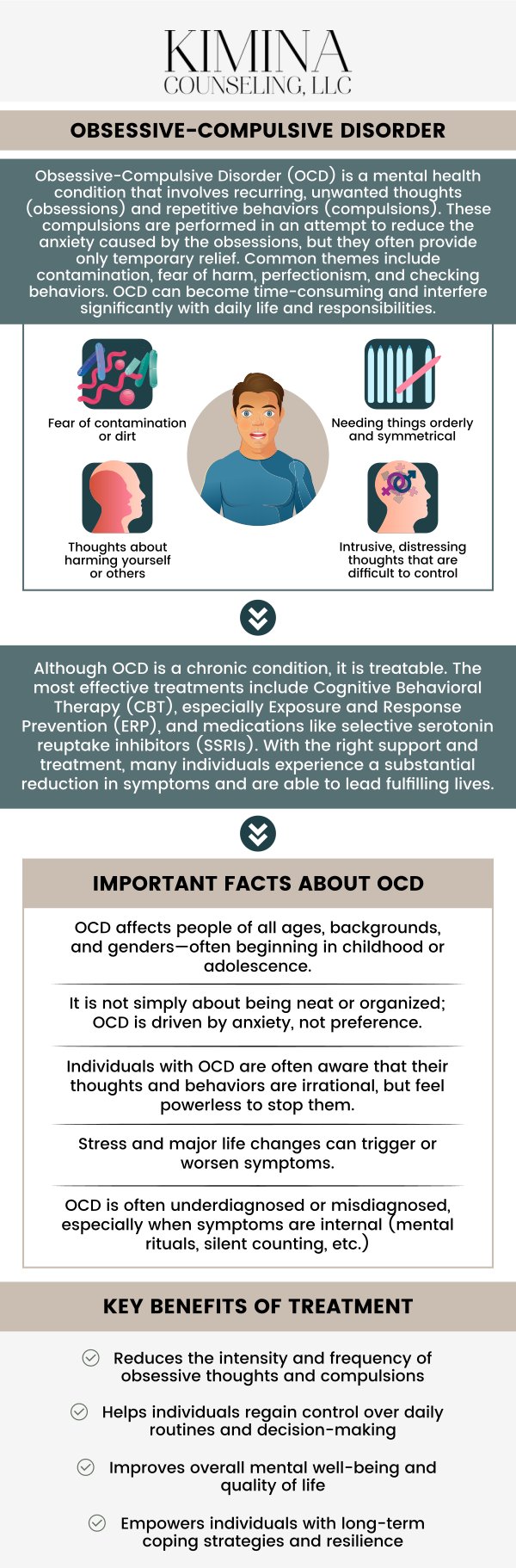
Table of Contents:
What does an OCD therapist do to help manage obsessive-compulsive disorder symptoms?
Who may benefit from working with an OCD therapist?
What should you expect during your first appointment with an OCD therapist?
How does an OCD therapist help patients develop healthier coping strategies?
How can our team support clients living with OCD?
Personalized OCD Support From Kimberly Sanchez, LMHC, and Amina Mazzara, LMHC at Kimina Counseling LLC
Obsessive-compulsive disorder can affect much more than routines or habits. Repetitive thoughts, persistent doubts, urges, and behaviors can take up significant mental energy and make ordinary activities feel difficult to manage. Working with an OCD therapist can help clients better understand these patterns, recognize what contributes to symptom cycles, and develop practical ways to respond differently.
At Kimina Counseling LLC, Kimberly Sanchez, LMHC, and Amina Mazzara, LMHC, provide personalized mental health support based on each client’s concerns, experiences, and goals. Our team works to create a comfortable setting where OCD symptoms can be discussed openly, and treatment can progress at an appropriate pace.
An OCD therapist begins by understanding how unwanted thoughts and repetitive behaviors affect a client’s everyday life. Obsessions may involve recurring thoughts, images, fears, or doubts that feel difficult to dismiss. Compulsions can include visible behaviors or internal mental rituals performed in an attempt to decrease anxiety or prevent a feared outcome.
During therapy, our team may explore when these patterns occur, what emotions accompany them, and how clients usually respond when obsessive thoughts appear. Understanding the relationship between an obsession, the anxiety it creates, and the compulsion that follows can provide an important foundation for treatment.
• OCD-focused support may address:
• Recurring intrusive thoughts or mental images
• Repetitive checking or reassurance seeking
• Fear of contamination or illness
• Concerns about mistakes or uncertainty
• Repetitive counting, ordering, or arranging
• Mental reviewing or repeating phrases internally
• Avoidance of situations associated with obsessive fears
• Distress when routines cannot be completed
• Interference with relationships, school, work, or daily responsibilities
At our clinic, Kimberly Sanchez, LMHC, and Amina Mazzara, LMHC, focus on understanding the individual rather than defining someone solely by symptoms. Our team can help clients recognize patterns and work toward more constructive ways of responding to distress.
Someone may consider working with an OCD therapist when obsessive thoughts, repetitive behaviors, or mental rituals begin interfering with daily functioning or emotional well-being. Symptoms can vary considerably. Some individuals experience noticeable compulsive behaviors, while others struggle primarily with internal rituals, persistent doubts, or unwanted thoughts that people around them may not recognize.
Professional support may be helpful when a person:
• Spends substantial time managing intrusive thoughts
• Repeatedly checks objects, situations, or decisions
• Frequently seeks reassurance from others
• Avoids activities because of specific fears
• Feels compelled to perform routines in a particular way
• Experiences significant distress when unable to complete a ritual
• Has difficulty concentrating because of recurring thoughts
• Finds that OCD patterns interfere with relationships or responsibilities
The presence of an unwanted thought alone does not necessarily mean a person has OCD. A careful mental health assessment can help clarify the nature of the symptoms and whether another concern may also be contributing.
At Kimina Counseling LLC, Kimberly Sanchez, LMHC, and Amina Mazzara, LMHC, consider the broader emotional picture when supporting clients. Our team takes into account personal history, current challenges, daily functioning, and individual treatment goals when developing care.
A first appointment is generally an opportunity to discuss current concerns and establish a clearer understanding of how symptoms are affecting everyday life. Clients do not need to arrive with a complete explanation of their symptoms or know exactly what treatment they need.
An OCD therapist may ask about when obsessive thoughts or repetitive behaviors began, how frequently they occur, what situations make them stronger, and what a client does to manage the resulting discomfort. Other areas of emotional health may also be discussed because anxiety, mood concerns, stressful experiences, and other factors can influence how symptoms are experienced.
An initial appointment may include:
• Discussing current obsessions or compulsive behaviors
• Reviewing when symptoms began
• Identifying common triggers
• Exploring how symptoms affect routines and relationships
• Discussing previous counseling or mental health care
• Reviewing current coping strategies
• Establishing personal goals for therapy
• Considering an individualized plan for continued support
At our clinic, Kimberly Sanchez, LMHC, and Amina Mazzara, LMHC, use the early stages of care to learn about each client’s circumstances and priorities. Our team also provides an opportunity for clients to ask questions and become more comfortable with the therapeutic process.
OCD can create a cycle in which an intrusive thought produces anxiety, a compulsion temporarily reduces that anxiety, and the pattern becomes more difficult to interrupt over time. Therapy can help clients begin recognizing this cycle and practice alternative responses that do not continually reinforce obsessive-compulsive patterns.
Healthier coping does not simply mean distracting oneself from every difficult thought. An OCD therapist can help clients build greater awareness of intrusive thoughts, emotional triggers, uncertainty, and the urge to perform rituals. Treatment may also focus on challenging unhelpful thinking patterns and learning ways to tolerate uncomfortable emotions more effectively.
Depending on individual needs, coping work can include:
• Identifying situations that intensify symptoms
• Recognizing connections between thoughts, emotions, and behaviors
• Developing methods for managing anxiety
• Reducing reliance on reassurance
• Building greater tolerance for uncertainty
• Challenging unhelpful interpretations of intrusive thoughts
• Strengthening emotional regulation
• Developing routines that support everyday functioning
• Tracking progress and recognizing changes over time
Evidence-based OCD treatment can also include cognitive behavioral approaches and, when appropriate, strategies specifically designed to reduce compulsive responses. The exact treatment plan should reflect the individual’s symptoms, clinical needs, and therapeutic goals.
Kimberly Sanchez, LMHC, and Amina Mazzara, LMHC, work with clients to develop practical strategies that can be applied beyond therapy sessions. Our team reviews progress as treatment continues and can adjust goals as challenges or needs change.
OCD symptoms can affect confidence, relationships, productivity, decision-making, and a person’s ability to feel comfortable with uncertainty. Our clinic provides a place to examine these concerns without judgment and better understand the patterns that may be keeping them active.
Our team can help clients:
• Identify obsessive-compulsive patterns
• Understand emotional and situational triggers
• Explore how OCD affects daily routines
• Develop healthier responses to intrusive thoughts
• Build strategies for managing anxiety and discomfort
• Work toward reducing behaviors that interfere with everyday life
• Establish realistic treatment goals
• Monitor progress as therapy continues
Treatment is personalized because OCD does not look identical for everyone. Kimberly Sanchez, LMHC, and Amina Mazzara, LMHC, consider each client’s experiences, strengths, concerns, and priorities when helping shape the direction of care.
At Kimina Counseling LLC, Kimberly Sanchez, LMHC, and Amina Mazzara, LMHC, provide individualized mental health care for clients experiencing OCD and related emotional concerns. Our clinic emphasizes a supportive therapeutic relationship where clients can discuss intrusive thoughts, repetitive behaviors, fears, and other concerns in a confidential and respectful environment.
Our team focuses on helping clients better understand how OCD patterns operate and identify strategies that support healthier responses to distress. Treatment goals can address emotional regulation, daily functioning, coping with uncertainty, and the ways obsessive-compulsive symptoms affect relationships, work, school, or personal routines.
For individuals looking for an OCD therapist, Kimina Counseling LLC offers personalized support centered on each client’s unique circumstances. Kimberly Sanchez, LMHC, and Amina Mazzara, LMHC, work with clients to build greater awareness of symptoms, strengthen useful coping skills, and pursue meaningful improvements in emotional well-being and everyday life. For more information, contact us or schedule an appointment online. We are conveniently located at 7 Midstate Drive, Suite 202, Auburn, MA 01501. We serve patients from Auburn MA, North Oxford MA, Worcester MA, Grafton MA, South Worcester MA, Newton Square MA, and surrounding areas.

Check Out Our 5 Star Reviews


Additional Services You May Need
▸ Individual Therapy
▸ Couples Conseling
▸ Family Counseling
▸ EMDR Therapy
▸ Anxiety
▸ Depression
▸ Trauma
▸ Post-traumatic stress disorder (PTSD)
▸ Bipolar Disorder
▸ Serious Mental Illness (SMI)
▸ Parenting and Post-Partum
▸ LGBTQ+
▸ Phobias
▸ Grief
▸ Attachment Disorders
▸ Personality Disorders
▸ Obsessive Compulsive Disorder
▸ Substance Use Disorders
▸ Family Conflict
▸ Attention Deficit (ADHD)
▸ Behavioral Therapy
▸ Anger Management

Additional Services You May Need
▸ Individual Therapy
▸ Couples Conseling
▸ Family Counseling
▸ EMDR Therapy
▸ Anxiety
▸ Depression
▸ Trauma
▸ Post-traumatic stress disorder (PTSD)
▸ Bipolar Disorder
▸ Serious Mental Illness (SMI)
▸ Parenting and Post-Partum
▸ LGBTQ+
▸ Phobias
▸ Grief
▸ Attachment Disorders
▸ Personality Disorders
▸ Obsessive Compulsive Disorder
▸ Substance Use Disorders
▸ Family Conflict
▸ Attention Deficit (ADHD)
▸ Behavioral Therapy
▸ Anger Management




 Send Text
 How May I Help You?